Dr. Lyuboslav Kostov
You have probably heard of the “Doomsday Clock.” This is a symbol representing the likelihood of a human-caused global catastrophe. It was created in 1947, shortly after the end of World War II. In reality, the clock is a metaphor rather than a prediction, illustrating the threats to humanity posed by unrestrained scientific and technological progress. It is a statistical metaphor for a hypothetical global catastrophe, signified by midnight on the clock. How close the world is to such a catastrophe, presented as a number of minutes or seconds before midnight, is assessed each January. The main factors influencing the clock are nuclear war, climate change and artificial intelligence. Over time, other factors have also been included, including demography.
The initial setting of the clock in 1947 was 7 minutes before midnight. Since then, it has been moved back 8 times and forward 17 times. The most distant point from midnight was 17 minutes in 1991, and the closest is 89 seconds, set in January 2025.
In light of recent global events, it appears that the clock will only grow more relevant. But instead of focusing on the danger of nuclear war, which plays a key role in the clock, especially in the short term, let us turn to another factor: demography. In the long run, demography has the potential to completely reshape the “rules of the game,” even to the point of humanity’s extinction.
If we assume that we start counting from around 50,000 BC, when modern Homo sapiens appeared on Earth, and we take into account that all population data are rough estimates and that a constant growth rate is applied across each period up to the present, scientists have already calculated that approximately 106 billion people have been born since the dawn of our species. This means that the current living population of Earth represents roughly 6% of all humans who have ever lived on the planet. But let’s look at the details.
The world population reached 1 billion for the first time only in 1804. It took thousands of years of evolution to reach a point where 1 billion people could coexist simultaneously on the planet. By contrast, the next little over 200 years completely changed the dynamic, largely due to the industrial revolutions, digitalization, globalization and urbanization.
For example, it took only 126 years for the planet’s population to grow from 1 billion to 2 billion, which occurred in 1930. After that, it took only 30 years to reach 3 billion (1960), just 14 more years to reach 4 billion (1974) and only another 12 years to reach 5 billion in 1986. Up to this point, it seemed as though exponential population growth had no end. Yet 1986 is the year after which the positive growth rate stopped increasing and entered a so-called “plateau.” Evidence for this lies in the fact that it took exactly 12 years for each additional billion in the period from 5 to 8 billion (1998: 6 billion; 2010: 7 billion; 2022: 8 billion).
According to UN population growth projections, this 12-year plateau that we have been in for nearly half a century will end, and the process will reverse, with the time needed to add each additional billion gradually increasing. Projections indicate that Earth will need 15 years to reach 9 billion (2037) and 23 years to reach 10 billion (2060). All of this is due to the declining positive growth rate, which in the mid-20th century was around 2 to 2.5 percent annually, while as of 2025 it is around 0.8 percent annually. This is a threefold reduction in global population growth. By the end of the 21st century, for the first time in human history since demographic data has been available, humanity will record a negative natural growth rate of around 0.1 to 0.2 percent, according to the latest UN projections. In other words, once we reach 10 billion, we will begin gradually shrinking. This is expected before the end of the 21st century.
Against this backdrop, many economic theories related to demography appear overturned. For example, in 1798, Malthus published his *Essay on the Principle of Population*. According to him, if left unchecked, humanity is heading toward demographic catastrophe because population increases geometrically while food supply grows arithmetically. Malthus was not right. Or if he was right, it is only until around 2100. After that, he is mistaken because he does not account for the technological and economic development of humanity. This prosperity, in turn, creates conditions for global polarization in demographic trends and ultimately leads to a reversal of the curve.
Digitalization will lead to a decline in global birthrates and to negative natural population growth after 2100. The truth is that the Fourth Industrial Revolution is the first one that will not lead to exponential population growth, but rather likely to its decline.
What happens on a regional level?
Figure 1: World population by region, 1950–2050. Source: UN, 2025
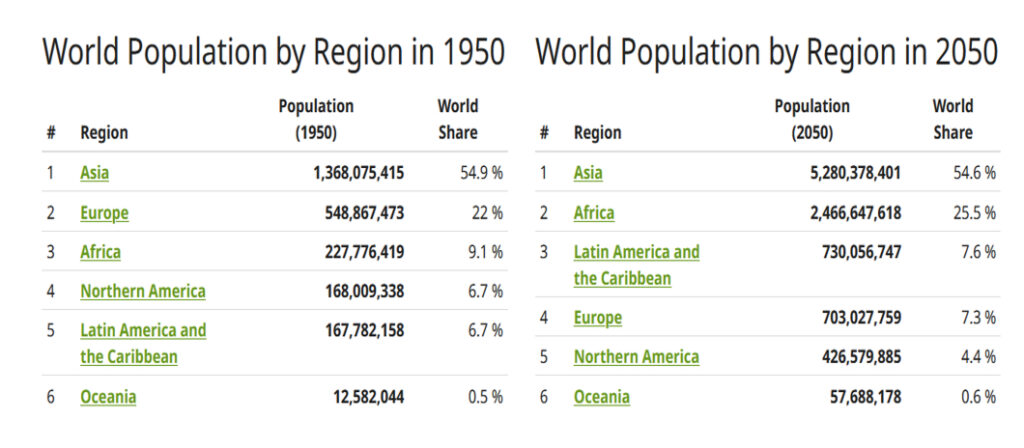
1. As seen in Figure 1, the share of the world’s population living on the European continent will drastically decline from 22 percent in 1950 to just 7.3 percent by 2050.
2. At the opposite pole is Africa, where by 2050 about 25.5 percent of the world’s population will live, compared with just 9.1 percent a century earlier.
3. By 2050, more than 80 percent of the global population will live on the continents of Africa and Asia.
Figure 2: Population change forecasts by region in the first half of the 21st century
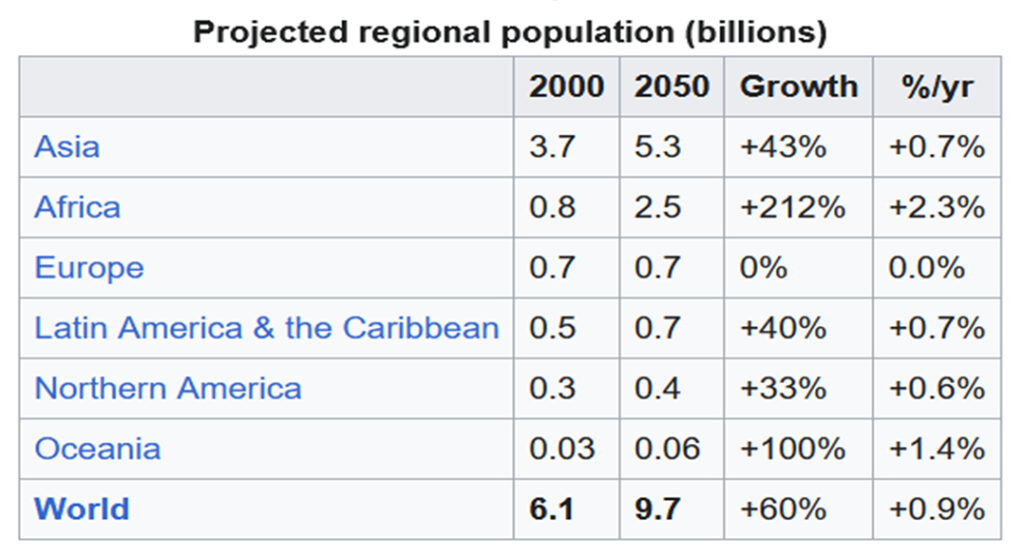
Figure 2 clearly shows that if we look only at the 21st century, there is positive natural population growth on all continents except Europe, where over 50 years almost no change is expected either in absolute numbers or in growth rate. By comparison, Africa’s population from 2000 to 2050 is expected to grow by 212 percent.
Against this background, the median age in Asia is 31, with 24 percent of the population under age 15. The median age in Africa is 18, with as much as 45 percent of the population under age 15 as of 2025. In North America, the median age is 35; in South America, 31; in Australia and Oceania, 32.
And Europe?
The median age in Europe today is 42, with only 16 percent of the population under age 15. UN projections suggest that by the end of this century, Europe’s median age will reach 48 to 50. Thus, not only is Europe the fastest-shrinking continent relative to the others, and the only one to have stopped recording positive natural growth already at the end of the 20th century, but it is also the oldest continent.
Why mention all this?
Because for a country or region to prosper economically, from a demographic perspective, two conditions are necessary, or at least one must be met: 1) a positive natural growth rate of around 2 percent annually and/or 2) a median population age under 40. There are exceptions, but statistically the likelihood of innovation and discovery declines if at least one of these conditions is not present. Unfortunately, Europe meets neither condition and has no mathematical chance of meeting them in the next 100 years.
Why is youth so important for a nation?
1. Thomas Edison invented the carbon-filament light bulb in 1876 at age 32.
2. James Watt improved the steam engine at age 29, sparking the Industrial Revolution in 1765.
3. Eugenio Barsanti created what is known as the internal combustion engine in 1853 at age 32.
4. Gutenberg invented the printing press at age 39.
5. Alexander Bell invented the telephone in 1876 at age 29.
6. Nikola Tesla invented the AC electrical system and wireless radio at age 37. A few years earlier, at 31, he invented the induction motor (1887).
7. Charles Goodyear discovered vulcanization at age 39.
8. Albert Einstein developed the Theory of Relativity in 1905 at age 26.
9. Dmitri Mendeleev created the Periodic Table in 1869 at age 35.
10. Niels Bohr proposed the atomic model in 1913 at age 28.
11. Watson and Crick discovered the structure of DNA (1953) at ages 25 and 37.
12. Blaise Pascal formulated the principle of hydraulics in 1647 at age 24.
13. Michael Faraday made his electromagnetism discoveries in 1821 at age 30.
14. Guglielmo Marconi invented the radio in 1895 at age 21.
15. John Atanasoff began work on the first computer at 36 and completed it at 39.
16. Robert Oppenheimer created the atomic bomb between ages 36 and 40.
In fact, all major scientific and technological breakthroughs that have propelled the world forward in recent centuries have been made by people under age 40. This is not a value judgment, just an empirical observation.
Against this backdrop, the continents of Africa, Asia, South America, North America and Australia meet at least one of the conditions, since their median ages are below 40. Africa meets both, as it also records more than 2 percent annual natural population growth.
All these numbers prompt the question: we know who owns the present, but who will own the future? Is this process reversible, and what role will artificial intelligence play by the end of this century? For comparison, global GDP in 2025 is estimated at around 110 trillion dollars, of which about 38 trillion are concentrated in the United States and the EU-27. Simple math shows that less than 10 percent of the global population currently holds 36 percent of global GDP, with the world’s 2,700 billionaires collectively owning around 14 trillion dollars, or about 12 percent of global GDP.
If we consider official projections for the size and structure of Earth’s population through the end of the 21st century, we can say with a high degree of confidence that by 2100 roughly 5–6 percent of the global population will hold around 45 percent of global GDP. This means even greater capital concentration in the hands of fewer people, rising regional and global inequalities, and intensifying contradictions and conflicts of all kinds.
We should not blindly believe, for example, that artificial intelligence will benefit everyone. Major economic growth or the next “economic miracle” occurs only under specific conditions. It does not occur where competition among employers is insufficient, workers have little or no power, and digitalization is relentless and widespread without prior planning. Those who can afford early access to new technologies will have a competitive advantage over all others. In conclusion, the differing levels of economic development among continents will reshape global demographic structures. And the European continent, if relying solely on its own human capital, is on a trajectory of diminishing relevance by the end of this century, in contrast with Africa and Asia. This, in turn, creates risks of migration and economic crises, including military conflicts.